Installing Stepped Fencing on a Driveway

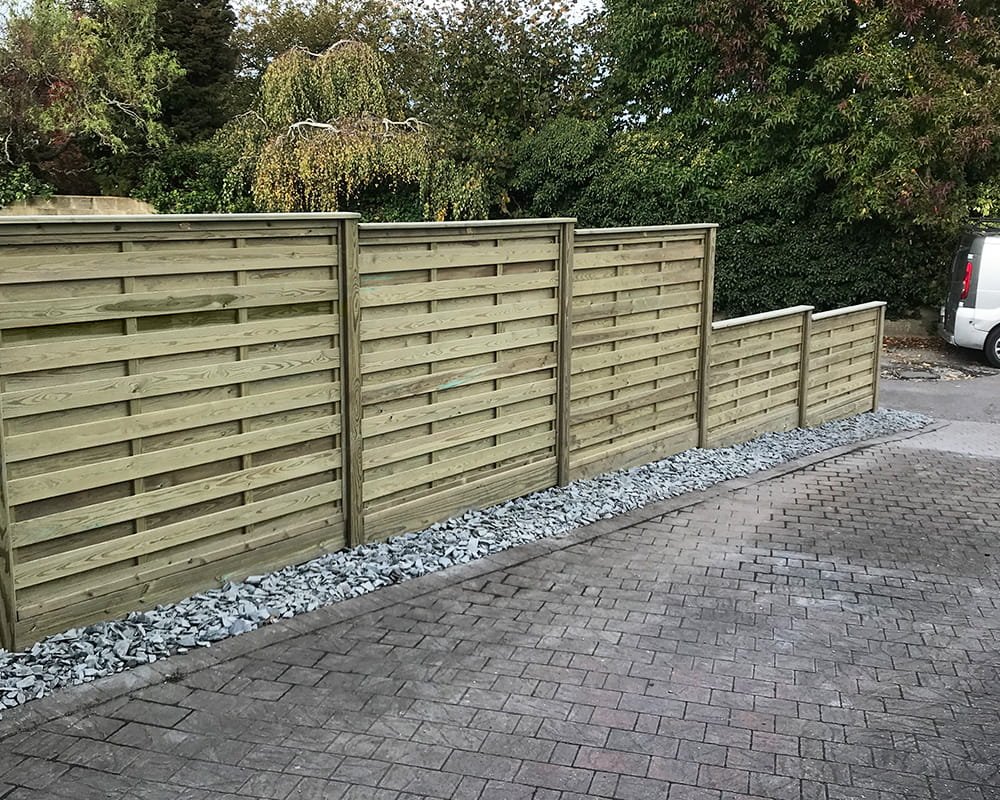
Jacksons Fencing described a project in which its approved installer, Fox Fencing and Landscaping, put several Horizontal Hit and Miss panels along a driveway for a client who wanted a clear boundary and more privacy from the neighbours. Previously only a thin strip of gravel separated the two driveways. The client chose the panels as a cost-effective, contemporary option and was drawn by the 25-year guarantee.
Jacksons explained that fencing on a gentle slope can be installed in one of two ways. Raking lets the fence follow the ground contours, while stepping, suited to panels held in slotted Jakposts, moves each panel up or down in level stages. Fox Fencing used stepping. On steeper ground Jacksons advises digging down at the higher end to make a level base and setting the gravel board at ground level so no gaps are left underneath.
The company stressed that its panels are not designed to go below ground, so a gravel board must sit between panel and soil, and one must be fitted for the guarantee to apply. A gravel board is a timber or concrete board of roughly 140mm that protects against damp ground, insects and debris, and Jacksons treats its boards with a stronger Jakcure solution so they can be in contact with the earth. Panels should always be kept level, checked with a spirit level, with the ground adjusted to suit rather than tilting the panel, since slanting would distort the posts and weaken the fence.
When panels are stepped, part of each post slot is left exposed above the panel. Jacksons supplies timber infill pieces matching the slot width, which are cut to length, treated at the cut end with preservative and fixed in place for a neat finish.
The client was so pleased that the installers were also asked about the back garden, where the aim was more privacy while still letting in sunlight. The same panels, made from 95mm boards spaced 8mm apart with a planed finish, were presented as suitable for that purpose.